ABM
What Is Account-Based Marketing? A Practical Guide for B2B Teams
What ABM is, how it works, and why it outperforms traditional lead gen for B2B teams.
What ABM is, how it works, and why it outperforms traditional lead gen for B2B teams.

Jean Bonnenfant, CMO
7 min read
·
Mar 24, 2026
Title
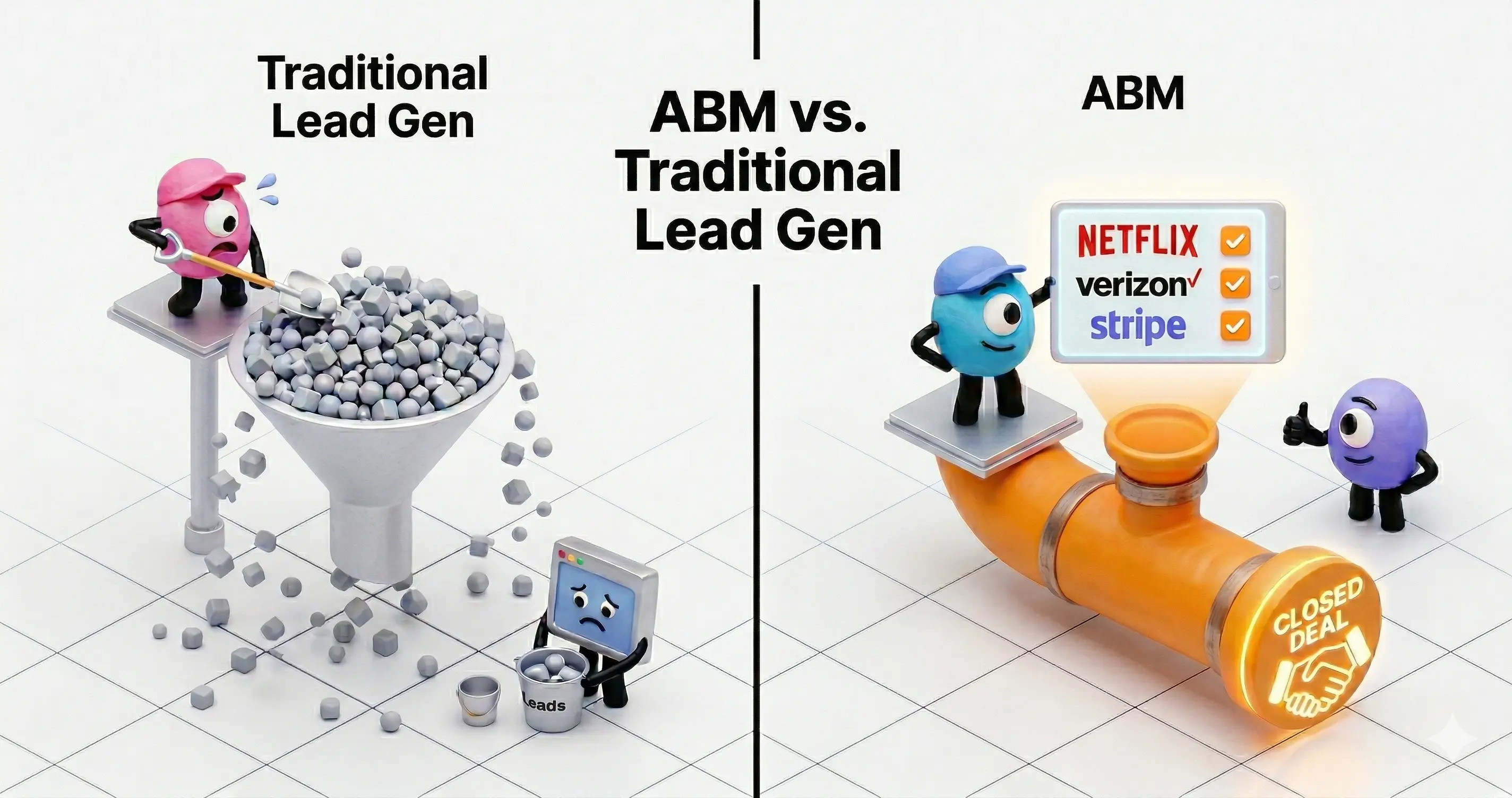
Most B2B marketing runs on a simple idea: cast a wide net, pull in a ton of leads, and let sales figure out who's worth talking to.
It sounds logical. It isn't.
You spend budget generating leads that never buy. Sales wastes time chasing contacts who were never a real fit. And conversion rates stay frustratingly low despite your spend going up.
Account-based marketing (ABM) fixes this by flipping the funnel entirely.
Instead of casting wide and filtering later, you start with the accounts you actually want to win and build everything around them.
This guide breaks down what ABM is, how it works, the different types, and when it makes sense for your team. No fluff, no vague theory. Just the practical stuff.
What Is Account-Based Marketing?
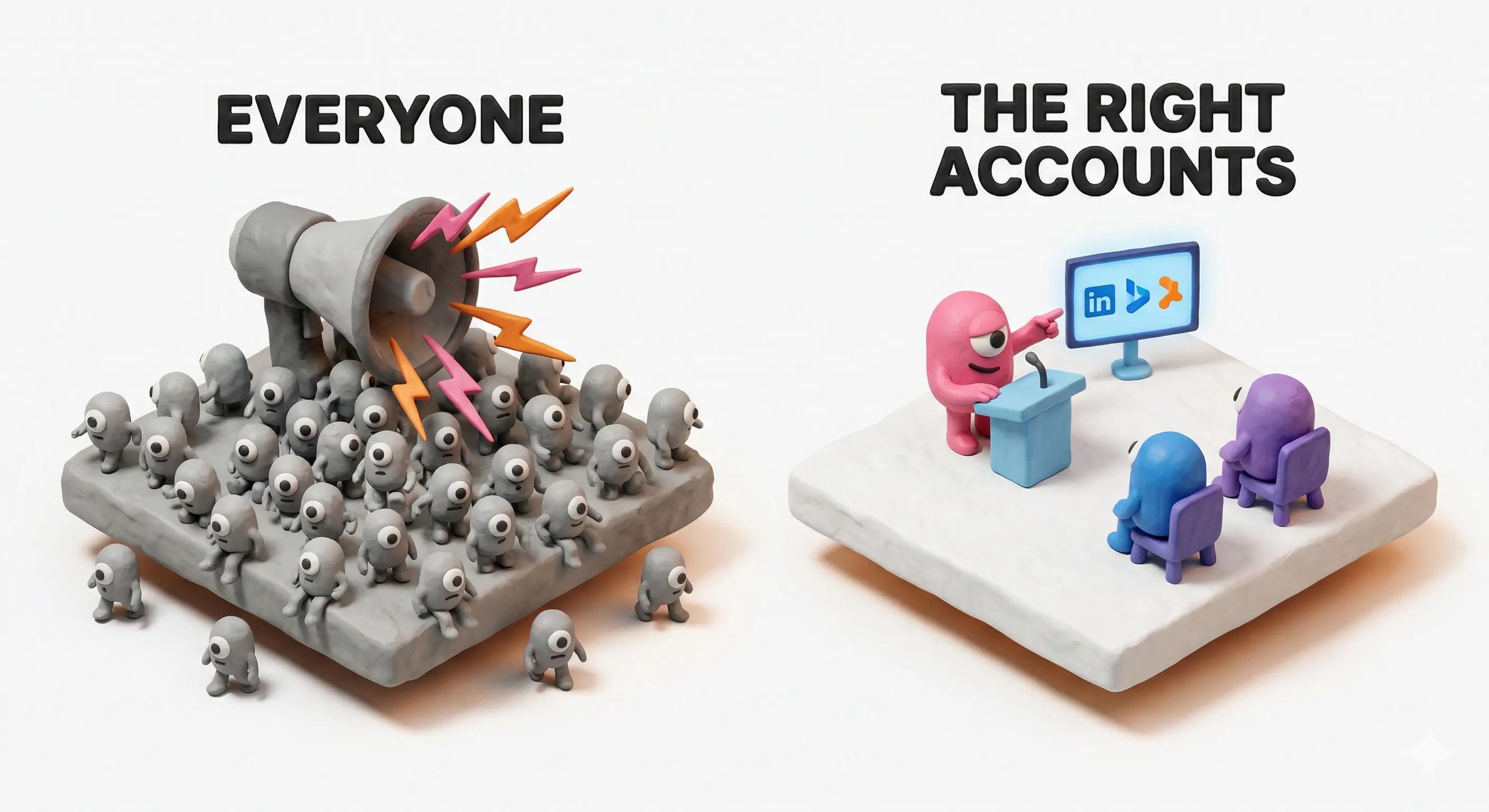
Account-based marketing (ABM) is a B2B strategy where you identify your highest-value target accounts first, then build personalized campaigns specifically for them instead of generating broad leads and hoping they convert.
It aligns sales and marketing around a shared list of accounts. You treat each account like its own market. You research them, understand their specific challenges, and create campaigns that speak directly to their world.
The result? Better conversations. Faster deals. Higher revenue.
The one-sentence version: ABM = identify your best-fit accounts, personalize everything for them, close bigger faster deals.
This isn't a new concept. Enterprise companies have been running some form of account-based selling for decades. What's changed is that modern tools now let mid-market and even smaller B2B teams run ABM at scale, without needing a 50-person marketing org to do it.
ABM vs. Traditional Lead Generation
The fastest way to understand ABM is to see how it's different from the spray-and-pray model most B2B teams default to.
Traditional Lead Gen | Account-Based Marketing | |
|---|---|---|
Starting point | Generate as many leads as possible | Define your ideal accounts first |
Target audience | Broad persona segments | Named companies and stakeholders |
Content approach | Generic content for everyone | Personalized per account or segment |
Sales & marketing | Often misaligned | Tightly coordinated from day one |
Primary metric | Lead volume | Account engagement, pipeline, revenue |
Best for | High-volume, low-ACV products | Complex B2B sales, high-ACV deals |
Traditional lead gen has its place. If you're selling a self-serve product at $50/month, you need volume. But the moment your average deal size gets into the thousands or tens of thousands, a volume approach is expensive and inefficient.
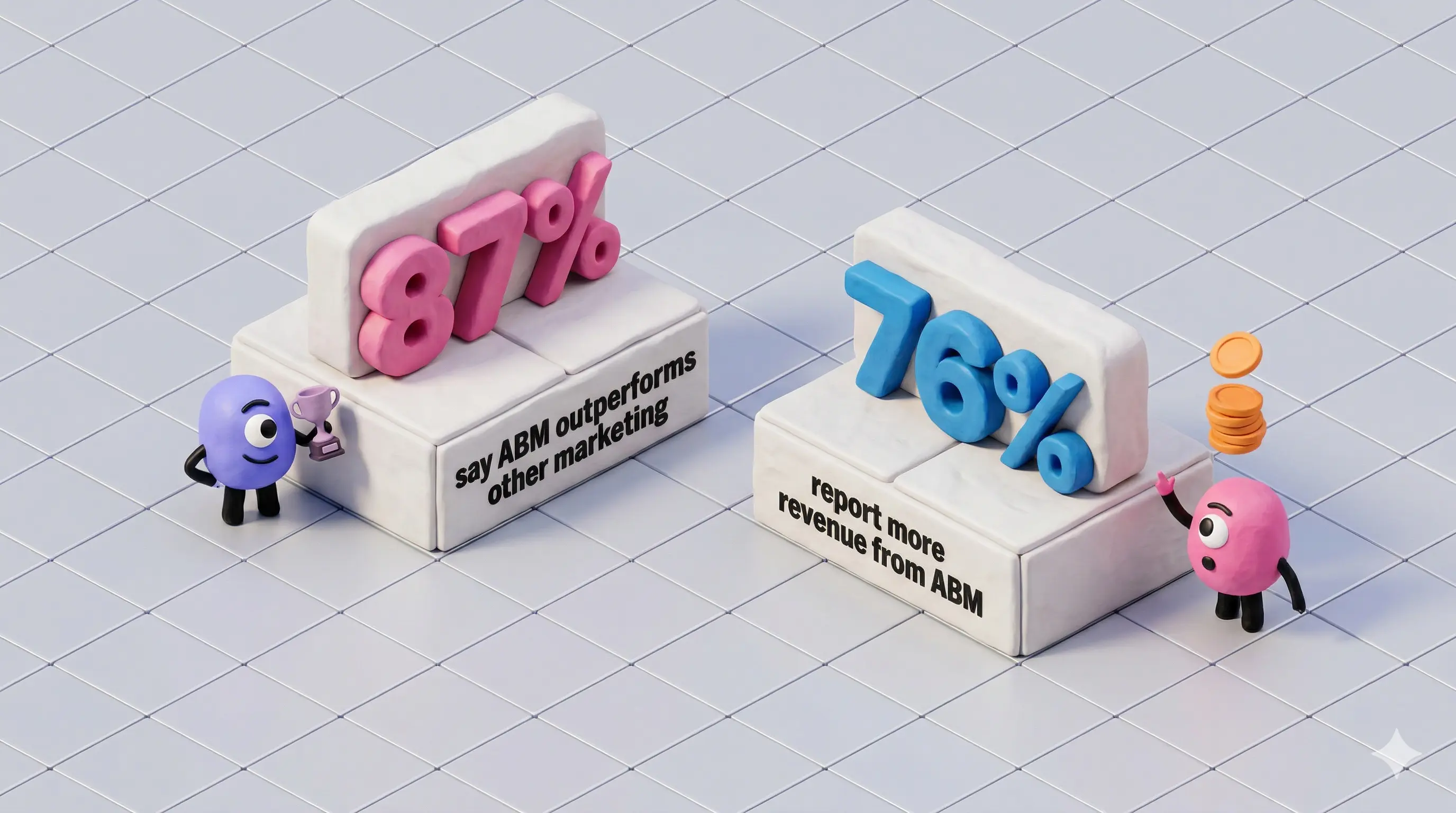
Companies running ABM consistently see higher pipeline growth. 76% of marketers report driving more revenue through ABM-targeted programs, and 87% say ABM outperforms other marketing initiatives. Those numbers are hard to ignore.
Why ABM Works
The mechanics of ABM are straightforward. When you know exactly who you're targeting, you can:
Research the account properly. You understand their industry, their specific challenges, who the decision-makers are, and what keeps the VP of Marketing up at night. That knowledge shapes every touchpoint.
Speak to their reality. A fintech company's pain points are different from a logistics company's. Customizing content by 20 to 30% results in an average 27% increase in engagement, according to LinkedIn data. That's not a small lift.
Coordinate sales and marketing. This is the part most teams underestimate. ABM doesn't work when sales and marketing are siloed. 93% of marketers say a fully aligned sales and marketing team is vital to a successful ABM strategy. ABM forces that alignment, because both teams are working toward the same target list.
Track what actually matters. Forget MQL counts. ABM shifts your metrics to account engagement, pipeline velocity, and deal size. Numbers that actually connect to revenue.

More than a mindset shift.
ABM doesn't just change your targeting. It changes how sales and marketing work together.
The 3 Types of ABM
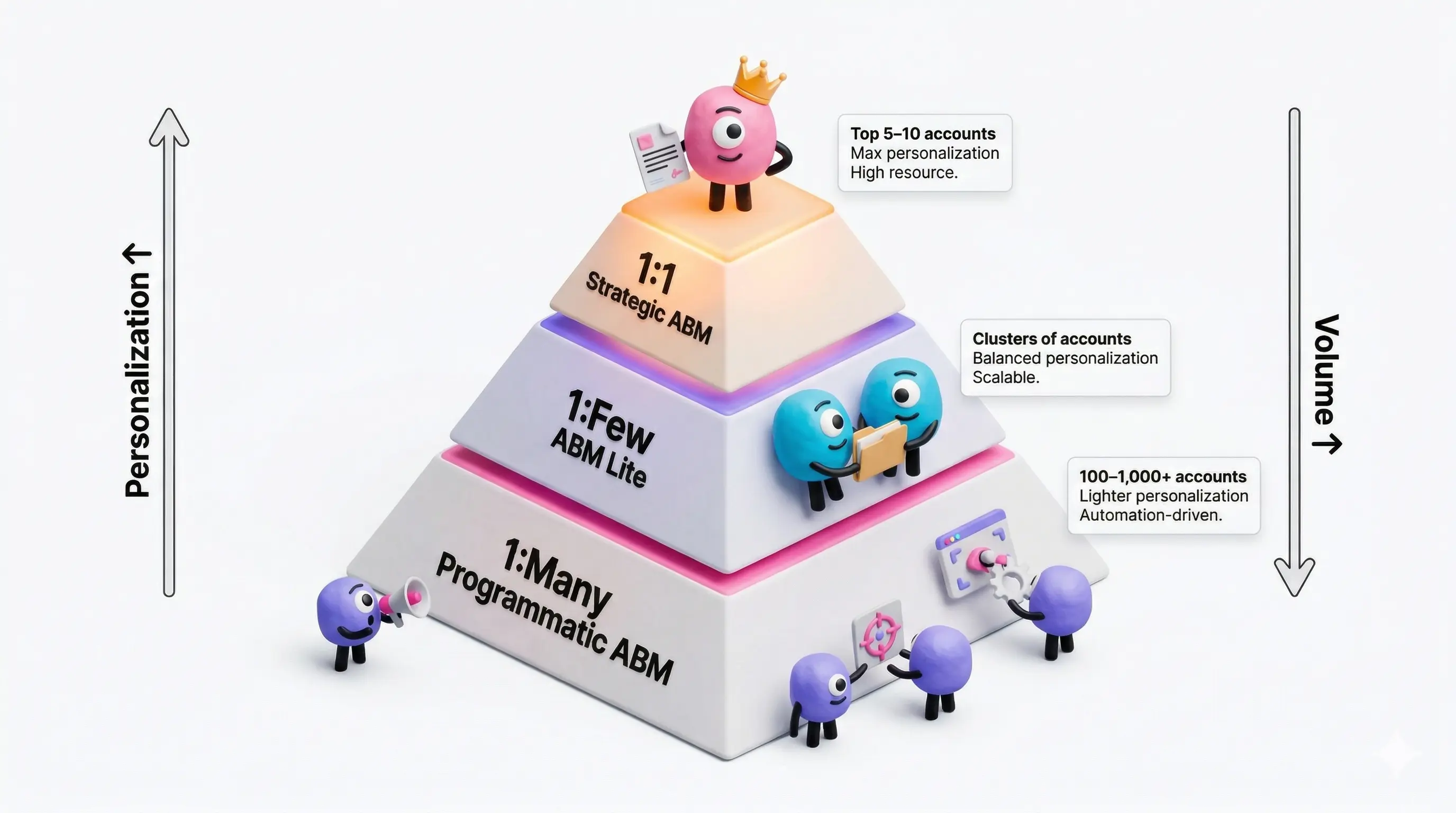
ABM isn't one-size-fits-all. There are three distinct approaches, and the right one depends on your resources, deal size, and how many accounts you're targeting.
Type | Accounts targeted | Personalization level | Resource investment | Best for |
|---|---|---|---|---|
1:1 (Strategic ABM) | 1 to 10 accounts | Fully custom per account | High | Your most strategic, highest-value accounts |
1:Few (ABM Lite) | 10 to 100 accounts | Semi-custom by segment/industry | Medium | Mid-tier accounts with shared characteristics |
1:Many (Programmatic ABM) | 100 to 1,000+ accounts | Broad personalization at scale | Low to medium | Awareness, demand gen, new market entry |
1:1 → Strategic ABM
This is ABM at its most intensive. You're building fully custom campaigns for individual accounts: bespoke content, personalized outreach, executive-level engagement, the works.
Strategic ABM requires significant time, resources, and budget. Sales and marketing work directly together on a tailored plan for each account, including custom content aligned to that specific company's business challenges.
Use this for your top 5 to 10 accounts. The ones where landing a deal would be transformational for your business.
1:Few → ABM Lite
ABM Lite is the middle ground. You group accounts by shared characteristics: same industry, same pain points, similar company size, and build campaigns for each cluster.
Instead of crafting completely bespoke campaigns for each account, you create campaigns for clusters using the commonalities among those accounts. It's a way to achieve personalization benefits while maintaining operational efficiency.
This is where most mid-market B2B teams should start. It's scalable without becoming generic.
1:Many → Programmatic ABM
Programmatic ABM applies account-based principles to hundreds of accounts using automation and targeted advertising. The personalization is lighter, but you're still targeting named accounts rather than firing into the void.
One-to-many ABM targets 100 to 1,000+ accounts and is ideal for businesses looking to maximize growth and generate leads at scale. It's especially effective for building awareness in a new market or warming up accounts before a more targeted push.
Most mature ABM programs use all three in combination: 1:1 for your highest-value targets, 1:few for your second tier, and 1:many for broad awareness.
How to Run an ABM Campaign: The Basics
You don't need a massive team to get started. Here's the stripped-down version of how it works.
1. Build your Ideal Customer Profile (ICP) Before you list accounts, you need to know what a perfect-fit customer looks like. Industry, company size, tech stack, team structure, buying signals. Get specific.
2. Build your target account list This is the core of ABM. You're creating a named list of companies that match your ICP. Use a combination of firmographic data, intent signals, and your CRM.
3. Map the buying committee B2B deals rarely have one decision-maker. Buying committees in typical B2B firms involve seven to eight people, each with different priorities. ABM coordinates engagement across all stakeholders simultaneously. You need to know who they are and what each of them cares about.
4. Personalize your outreach and content This is where ABM either works or doesn't. Generic content kills ABM campaigns. You need messaging that speaks to the account's specific context: their industry, their size, their likely challenges.
5. Coordinate across channels ABM is a multi-channel play. LinkedIn Ads, email, direct outreach, content. They all need to tell the same story and hit the same accounts from different angles.
6. Track account-level metrics Stop counting leads. Start tracking account engagement scores, pipeline velocity, deal size, and win rates for your target accounts versus non-target accounts.

One thing most teams skip.
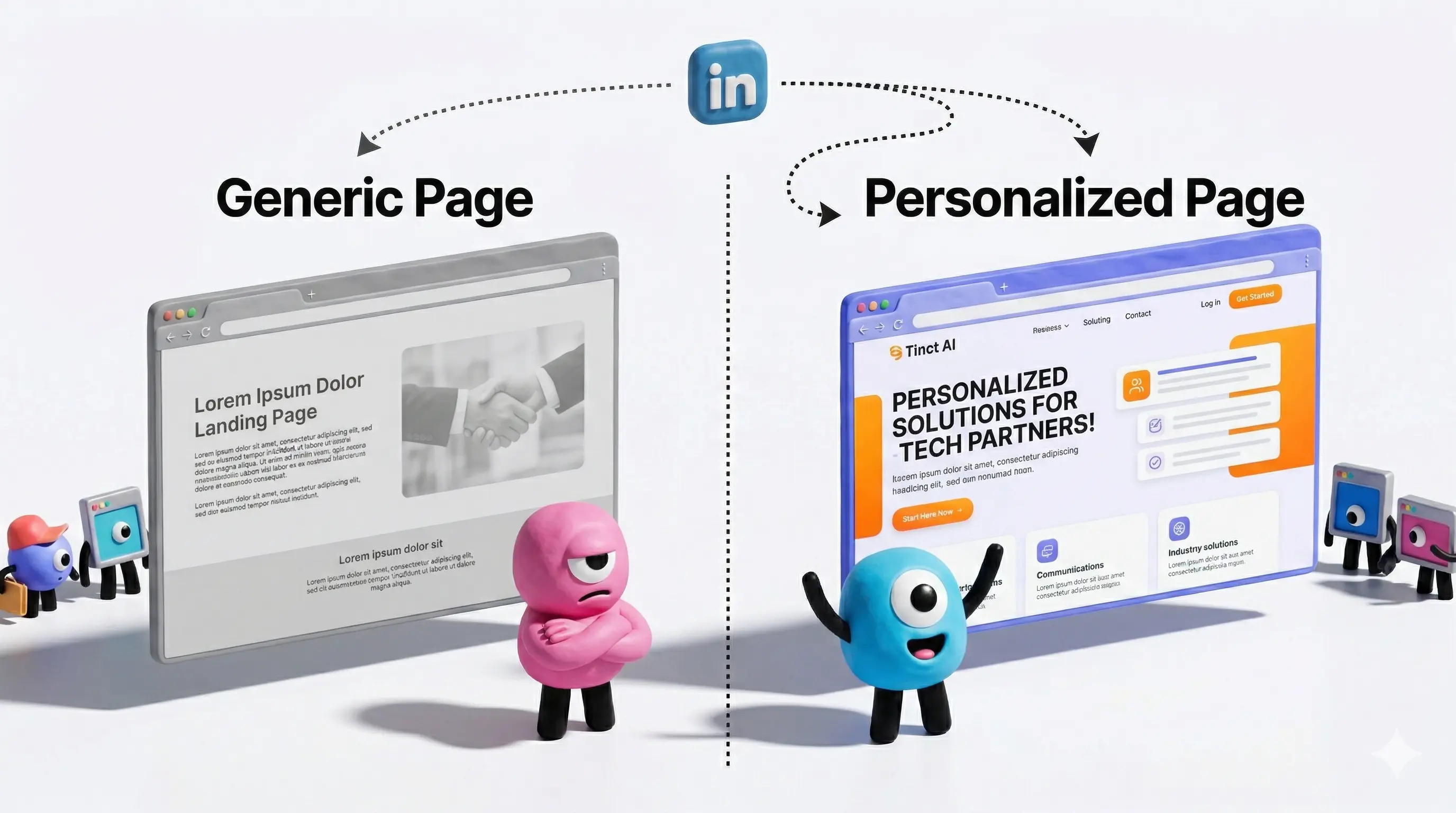
Personalizing the landing page. You can run perfect LinkedIn Ads targeting the right accounts and then lose them the moment they hit a generic page. The ad and the landing page need to speak the same language.
Who ABM Is (and Isn't) For
ABM is not right for every B2B business. Here's a quick read on whether it fits your situation.
ABM works well when:
Your average deal size is high (generally $10K+ ACV)
You have a clearly defined ICP and know which companies you want to win
Your sales cycle is complex and involves multiple stakeholders
You have some sales-marketing alignment or are willing to build it
ABM is harder when:
You're early-stage and don't know your ICP yet
Your product is low-ACV and high-volume (think: self-serve SaaS at $20/month)
Sales and marketing are operating in completely separate worlds
You have zero budget for personalization or content creation
About 72% of B2B companies now use some form of ABM strategy, and companies using ABM report 28% faster sales cycles on average. But adoption doesn't mean every company is running it well. Most teams are still in early stages.
Only 17% of marketers have fully developed ABM strategies. The rest are still figuring out how to implement one.
That's actually a good thing if you're starting now. There's still a real competitive advantage available to teams who get the execution right.
The Landing Page Problem Nobody Talks About
Here's something that gets overlooked in almost every ABM guide.
You can do everything right: perfect ICP definition, solid target account list, killer LinkedIn Ads. And still get mediocre results. Because when those accounts click your ad, they land on a generic page that could have been written for anyone.
Think about it. You're running LinkedIn Ads specifically targeting the CFO of a 200-person logistics company. Your ad speaks to logistics pain points. They click. They land on a page that talks about "streamlining business operations" with a stock photo of a handshake.
You just wasted that click.
Hyper-personalization in ABM campaigns is responsible for a 20% increase in engagement and a 10 to 15% boost in conversion rates. The personalization has to extend all the way to the landing page, not just the ad.
This is exactly what Tinct AI solves. It generates personalized landing pages for every account on your ABM list, automatically. The CFO of that logistics company lands on a page built for their world: their industry's challenges, relevant proof points, and messaging that feels like it was written specifically for them.
Setup takes under 30 minutes. And there's a free tier to start.
The Numbers on ABM in 2025
If you're still on the fence, here's where the market stands.
ABM campaigns achieve 208% more revenue from key accounts compared to other methods. Average engagement rates for ABM are 3x higher than spray-and-pray approaches (25% vs. 8%). ABM delivers an average ROI of 5:1, with top performers at 10:1 or higher.
The overall ABM market is expected to grow from $2.5 billion in 2024 to $5.8 billion by 2032.
84% of businesses say ABM helps retain and expand existing client relationships. It's not just a new-business play. Mature ABM teams use it to grow accounts they've already won.
The adoption wave is real. The question is whether your team is going to run ABM properly or just tick the checkbox and wonder why it isn't working.
Getting Started
You don't need to boil the ocean on day one.
Start small. Pick 20 accounts that match your ICP closely. Research them properly. Personalize your outreach. Run a 90-day test and see what moves.
Most teams who start ABM with that discipline end up scaling it. Because the results are hard to argue with.
The teams who struggle are the ones who declare they're "doing ABM" and then send the same email blast to 5,000 contacts with a company name merge field. That's not ABM. That's just spam with extra steps.
Real ABM is about relevance. And relevance takes work, but less work than you think once you have the right systems in place.
If personalized landing pages are the gap in your ABM stack, Tinct is worth a look. Five pages free. No sales call required.
FAQ
What is account-based marketing (ABM) in simple terms?

Account-based marketing is a B2B strategy where you identify specific high-value companies you want to win as customers, then build personalized marketing campaigns tailored to each of those companies. Instead of generating broad leads and hoping some convert, you start with the accounts you want and work backward from there. The goal is to engage the right companies with the right message at the right time.
How is ABM different from lead generation?
Lead generation casts a wide net. You create content and ads for a broad audience and filter out the leads who aren't a fit after the fact. ABM flips that. You define your target accounts first, then build campaigns specifically for them. ABM is more targeted, more resource-intensive per account, but typically delivers higher conversion rates, larger deal sizes, and faster sales cycles, especially for companies with high average contract values.
What are the three types of ABM?
The three main types are: 1:1 (Strategic ABM), where you build fully custom campaigns for individual high-value accounts; 1:Few (ABM Lite), where you group similar accounts and create semi-personalized campaigns for each cluster; and 1:Many (Programmatic ABM), where you apply account-based targeting to hundreds of accounts at scale using automation. Most mature ABM programs use a combination of all three, matched to account tiers.
How do you measure ABM success?
ABM uses different metrics than traditional marketing. Instead of tracking lead volume or MQLs, you track account engagement scores (how much your target accounts are interacting with your content and ads), pipeline velocity (how fast deals move through the funnel), win rates for target accounts versus non-target accounts, and average contract value. Revenue impact is the ultimate measure.
What do you need to start ABM?
You need three things: a clearly defined Ideal Customer Profile (ICP), a named target account list based on that ICP, and the ability to personalize your outreach and content for those accounts. You don't need expensive technology to start. A focused list of 20 to 30 accounts, personalized LinkedIn Ads, tailored email sequences, and a landing page that speaks to each account's context will get you further than most teams get with six-figure ABM platforms.
Why do most ABM campaigns underperform?
The most common failure is running personalized ads that send traffic to generic landing pages. You've done the work to target the right person at the right company, then lost them the moment they land on a page that could have been written for anyone. Other common failures: lack of sales-marketing alignment, not enough research on target accounts, and expecting results in weeks from a strategy that takes months to mature.
Most B2B marketing runs on a simple idea: cast a wide net, pull in a ton of leads, and let sales figure out who's worth talking to.
It sounds logical. It isn't.
You spend budget generating leads that never buy. Sales wastes time chasing contacts who were never a real fit. And conversion rates stay frustratingly low despite your spend going up.
Account-based marketing (ABM) fixes this by flipping the funnel entirely.
Instead of casting wide and filtering later, you start with the accounts you actually want to win and build everything around them.
This guide breaks down what ABM is, how it works, the different types, and when it makes sense for your team. No fluff, no vague theory. Just the practical stuff.
What Is Account-Based Marketing?
Account-based marketing (ABM) is a B2B strategy where you identify your highest-value target accounts first, then build personalized campaigns specifically for them instead of generating broad leads and hoping they convert.
It aligns sales and marketing around a shared list of accounts. You treat each account like its own market. You research them, understand their specific challenges, and create campaigns that speak directly to their world.
The result? Better conversations. Faster deals. Higher revenue.
The one-sentence version: ABM = identify your best-fit accounts, personalize everything for them, close bigger faster deals.
This isn't a new concept. Enterprise companies have been running some form of account-based selling for decades. What's changed is that modern tools now let mid-market and even smaller B2B teams run ABM at scale, without needing a 50-person marketing org to do it.
ABM vs. Traditional Lead Generation
The fastest way to understand ABM is to see how it's different from the spray-and-pray model most B2B teams default to.
Traditional Lead Gen | Account-Based Marketing | |
|---|---|---|
Starting point | Generate as many leads as possible | Define your ideal accounts first |
Target audience | Broad persona segments | Named companies and stakeholders |
Content approach | Generic content for everyone | Personalized per account or segment |
Sales & marketing | Often misaligned | Tightly coordinated from day one |
Primary metric | Lead volume | Account engagement, pipeline, revenue |
Best for | High-volume, low-ACV products | Complex B2B sales, high-ACV deals |
Traditional lead gen has its place. If you're selling a self-serve product at $50/month, you need volume. But the moment your average deal size gets into the thousands or tens of thousands, a volume approach is expensive and inefficient.
Companies running ABM consistently see higher pipeline growth. 76% of marketers report driving more revenue through ABM-targeted programs, and 87% say ABM outperforms other marketing initiatives. Those numbers are hard to ignore.
Why ABM Works
The mechanics of ABM are straightforward. When you know exactly who you're targeting, you can:
Research the account properly. You understand their industry, their specific challenges, who the decision-makers are, and what keeps the VP of Marketing up at night. That knowledge shapes every touchpoint.
Speak to their reality. A fintech company's pain points are different from a logistics company's. Customizing content by 20 to 30% results in an average 27% increase in engagement, according to LinkedIn data. That's not a small lift.
Coordinate sales and marketing. This is the part most teams underestimate. ABM doesn't work when sales and marketing are siloed. 93% of marketers say a fully aligned sales and marketing team is vital to a successful ABM strategy. ABM forces that alignment, because both teams are working toward the same target list.
Track what actually matters. Forget MQL counts. ABM shifts your metrics to account engagement, pipeline velocity, and deal size. Numbers that actually connect to revenue.
More than a mindset shift.
ABM doesn't just change your targeting. It changes how sales and marketing work together.
The 3 Types of ABM
ABM isn't one-size-fits-all. There are three distinct approaches, and the right one depends on your resources, deal size, and how many accounts you're targeting.
Type | Accounts targeted | Personalization level | Resource investment | Best for |
|---|---|---|---|---|
1:1 (Strategic ABM) | 1 to 10 accounts | Fully custom per account | High | Your most strategic, highest-value accounts |
1:Few (ABM Lite) | 10 to 100 accounts | Semi-custom by segment/industry | Medium | Mid-tier accounts with shared characteristics |
1:Many (Programmatic ABM) | 100 to 1,000+ accounts | Broad personalization at scale | Low to medium | Awareness, demand gen, new market entry |
1:1 → Strategic ABM
This is ABM at its most intensive. You're building fully custom campaigns for individual accounts: bespoke content, personalized outreach, executive-level engagement, the works.
Strategic ABM requires significant time, resources, and budget. Sales and marketing work directly together on a tailored plan for each account, including custom content aligned to that specific company's business challenges.
Use this for your top 5 to 10 accounts. The ones where landing a deal would be transformational for your business.
1:Few → ABM Lite
ABM Lite is the middle ground. You group accounts by shared characteristics: same industry, same pain points, similar company size, and build campaigns for each cluster.
Instead of crafting completely bespoke campaigns for each account, you create campaigns for clusters using the commonalities among those accounts. It's a way to achieve personalization benefits while maintaining operational efficiency.
This is where most mid-market B2B teams should start. It's scalable without becoming generic.
1:Many → Programmatic ABM
Programmatic ABM applies account-based principles to hundreds of accounts using automation and targeted advertising. The personalization is lighter, but you're still targeting named accounts rather than firing into the void.
One-to-many ABM targets 100 to 1,000+ accounts and is ideal for businesses looking to maximize growth and generate leads at scale. It's especially effective for building awareness in a new market or warming up accounts before a more targeted push.
Most mature ABM programs use all three in combination: 1:1 for your highest-value targets, 1:few for your second tier, and 1:many for broad awareness.
How to Run an ABM Campaign: The Basics
You don't need a massive team to get started. Here's the stripped-down version of how it works.
1. Build your Ideal Customer Profile (ICP) Before you list accounts, you need to know what a perfect-fit customer looks like. Industry, company size, tech stack, team structure, buying signals. Get specific.
2. Build your target account list This is the core of ABM. You're creating a named list of companies that match your ICP. Use a combination of firmographic data, intent signals, and your CRM.
3. Map the buying committee B2B deals rarely have one decision-maker. Buying committees in typical B2B firms involve seven to eight people, each with different priorities. ABM coordinates engagement across all stakeholders simultaneously. You need to know who they are and what each of them cares about.
4. Personalize your outreach and content This is where ABM either works or doesn't. Generic content kills ABM campaigns. You need messaging that speaks to the account's specific context: their industry, their size, their likely challenges.
5. Coordinate across channels ABM is a multi-channel play. LinkedIn Ads, email, direct outreach, content. They all need to tell the same story and hit the same accounts from different angles.
6. Track account-level metrics Stop counting leads. Start tracking account engagement scores, pipeline velocity, deal size, and win rates for your target accounts versus non-target accounts.
One thing most teams skip.
Personalizing the landing page. You can run perfect LinkedIn Ads targeting the right accounts and then lose them the moment they hit a generic page. The ad and the landing page need to speak the same language.
Who ABM Is (and Isn't) For
ABM is not right for every B2B business. Here's a quick read on whether it fits your situation.
ABM works well when:
Your average deal size is high (generally $10K+ ACV)
You have a clearly defined ICP and know which companies you want to win
Your sales cycle is complex and involves multiple stakeholders
You have some sales-marketing alignment or are willing to build it
ABM is harder when:
You're early-stage and don't know your ICP yet
Your product is low-ACV and high-volume (think: self-serve SaaS at $20/month)
Sales and marketing are operating in completely separate worlds
You have zero budget for personalization or content creation
About 72% of B2B companies now use some form of ABM strategy, and companies using ABM report 28% faster sales cycles on average. But adoption doesn't mean every company is running it well. Most teams are still in early stages.
Only 17% of marketers have fully developed ABM strategies. The rest are still figuring out how to implement one.
That's actually a good thing if you're starting now. There's still a real competitive advantage available to teams who get the execution right.
The Landing Page Problem Nobody Talks About
Here's something that gets overlooked in almost every ABM guide.
You can do everything right: perfect ICP definition, solid target account list, killer LinkedIn Ads. And still get mediocre results. Because when those accounts click your ad, they land on a generic page that could have been written for anyone.
Think about it. You're running LinkedIn Ads specifically targeting the CFO of a 200-person logistics company. Your ad speaks to logistics pain points. They click. They land on a page that talks about "streamlining business operations" with a stock photo of a handshake.
You just wasted that click.
Hyper-personalization in ABM campaigns is responsible for a 20% increase in engagement and a 10 to 15% boost in conversion rates. The personalization has to extend all the way to the landing page, not just the ad.
This is exactly what Tinct AI solves. It generates personalized landing pages for every account on your ABM list, automatically. The CFO of that logistics company lands on a page built for their world: their industry's challenges, relevant proof points, and messaging that feels like it was written specifically for them.
Setup takes under 30 minutes. And there's a free tier to start.
The Numbers on ABM in 2025
If you're still on the fence, here's where the market stands.
ABM campaigns achieve 208% more revenue from key accounts compared to other methods. Average engagement rates for ABM are 3x higher than spray-and-pray approaches (25% vs. 8%). ABM delivers an average ROI of 5:1, with top performers at 10:1 or higher.
The overall ABM market is expected to grow from $2.5 billion in 2024 to $5.8 billion by 2032.
84% of businesses say ABM helps retain and expand existing client relationships. It's not just a new-business play. Mature ABM teams use it to grow accounts they've already won.
The adoption wave is real. The question is whether your team is going to run ABM properly or just tick the checkbox and wonder why it isn't working.
Getting Started
You don't need to boil the ocean on day one.
Start small. Pick 20 accounts that match your ICP closely. Research them properly. Personalize your outreach. Run a 90-day test and see what moves.
Most teams who start ABM with that discipline end up scaling it. Because the results are hard to argue with.
The teams who struggle are the ones who declare they're "doing ABM" and then send the same email blast to 5,000 contacts with a company name merge field. That's not ABM. That's just spam with extra steps.
Real ABM is about relevance. And relevance takes work, but less work than you think once you have the right systems in place.
If personalized landing pages are the gap in your ABM stack, Tinct is worth a look. Five pages free. No sales call required.
FAQ
What is account-based marketing (ABM) in simple terms?
Account-based marketing is a B2B strategy where you identify specific high-value companies you want to win as customers, then build personalized marketing campaigns tailored to each of those companies. Instead of generating broad leads and hoping some convert, you start with the accounts you want and work backward from there. The goal is to engage the right companies with the right message at the right time.
How is ABM different from lead generation?
Lead generation casts a wide net. You create content and ads for a broad audience and filter out the leads who aren't a fit after the fact. ABM flips that. You define your target accounts first, then build campaigns specifically for them. ABM is more targeted, more resource-intensive per account, but typically delivers higher conversion rates, larger deal sizes, and faster sales cycles, especially for companies with high average contract values.
What are the three types of ABM?
The three main types are: 1:1 (Strategic ABM), where you build fully custom campaigns for individual high-value accounts; 1:Few (ABM Lite), where you group similar accounts and create semi-personalized campaigns for each cluster; and 1:Many (Programmatic ABM), where you apply account-based targeting to hundreds of accounts at scale using automation. Most mature ABM programs use a combination of all three, matched to account tiers.
How do you measure ABM success?
ABM uses different metrics than traditional marketing. Instead of tracking lead volume or MQLs, you track account engagement scores (how much your target accounts are interacting with your content and ads), pipeline velocity (how fast deals move through the funnel), win rates for target accounts versus non-target accounts, and average contract value. Revenue impact is the ultimate measure.
What do you need to start ABM?
You need three things: a clearly defined Ideal Customer Profile (ICP), a named target account list based on that ICP, and the ability to personalize your outreach and content for those accounts. You don't need expensive technology to start. A focused list of 20 to 30 accounts, personalized LinkedIn Ads, tailored email sequences, and a landing page that speaks to each account's context will get you further than most teams get with six-figure ABM platforms.
Why do most ABM campaigns underperform?
The most common failure is running personalized ads that send traffic to generic landing pages. You've done the work to target the right person at the right company, then lost them the moment they land on a page that could have been written for anyone. Other common failures: lack of sales-marketing alignment, not enough research on target accounts, and expecting results in weeks from a strategy that takes months to mature.